

How much do I need to retire?
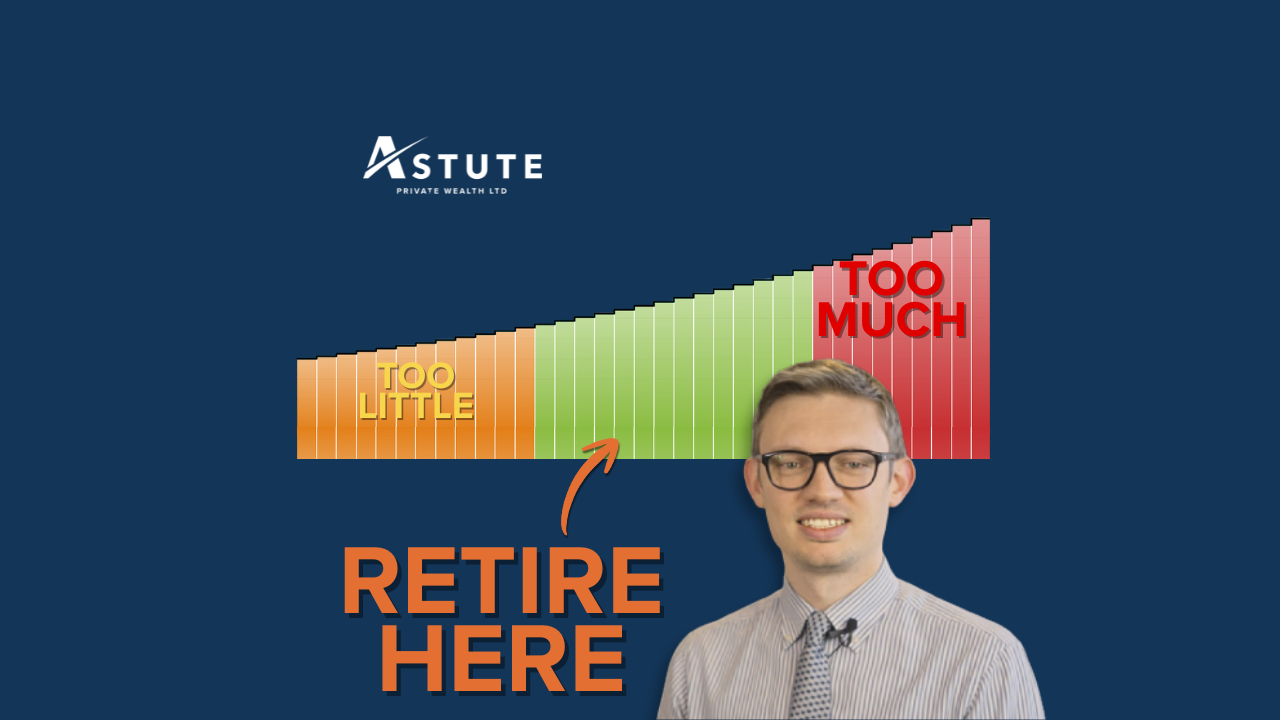
It’s probably the most common question we’re asked as Financial Planners. And it makes sense; retirement is a huge life change. You’re shifting from earning and saving money to spending down what you’ve built up; changing the habit of a lifetime. You want to make sure you’re doing it safely, that you won’t run out, and that you can actually enjoy it. “Have I got enough?”, “what if I spend too much?”, “what if I spend too little?”
These are perfectly sensible questions, but the truth is… they are not simple ones to answer…
Join us as we explore why this is such a difficult topic to quantify, why some people have retirement planning all wrong, why some of the DIY approaches fall short, and how we tackle this problem in a comprehensive and truly bespoke manner to bring you the peace of mind you’re seeking. PLUS, keep watching to get access to one of the tools we use at the start of this particular journey – our Retirement Budget Tool – which will hopefully give you some food for thought, and get you started on your plan for retirement.
Hello and welcome to the latest Insightful Planning with Astute video. I’m Elliot Unsworth, Head of Client Proposition at Astute Private Wealth, and today I’m going to explore the answer to one of the most pertinent questions posed to us by our clients: how much do I need to retire?
Before we get into it, if you already have the benefit of working with Astute and have questions after watching this, please don’t hesitate to get in touch with your Financial Planner. If you’re new to us, we’ve left a link below this video to help guide you to the right place.
A fair number of people expect a nice, neat formula. Something like: “If you’ve got £500,000, you’re good to go” or, “You need 25 times your annual spending”. And while these sorts of rules can be helpful starting points, they often miss the bigger picture. Because the real answer depends on you: your life, your values, and your plans; no two retirements are the same.
Take this very basic example comparing two individuals who are making plans to retire. One has a £1mn pension pot and the other has £500,000; which one has enough to retire comfortably? And please note that “comfortable” is entirely subjective. On the face of it…well…the person with the million-pound pot, surely? Well, what if I told you that the first person wants to retire at ? A quick analysis of this shows that, actually, the answer is the second person, even though they have half the capital of the first. No two retirements are the same.
If you try to solve this quandary yourself, you can head online, and you’ll find some shortcuts to answering the question. One of the most common is what’s known as the “4% Rule.” It’s based on research that says if you withdraw 4% of your retirement pot each year, adjusted for inflation, there’s a good chance it’ll last you about 30 years. So, if you’ve got £500,000, 4% of that is £20,000 a year. Add on your State Pension, and that gives you a rough retirement income.
Now, it’s not a bad place to start, and it’s certainly better than nothing. But it’s based on averages. Average markets. Average lifespans. Average inflation. However, averages are largely irrelevant when it comes to comprehensive lifestyle Financial Planning; you are unlikely to be average!
It means that, in the vast majority of cases, the 4% rule can fall short. You might spend too much too early. On the other hand, you might be too cautious and not enjoy your money when you could. This is the problem with a simple rule — it tells you nothing about your circumstances.
And it certainly doesn’t take into account key factors like which of your assets you withdraw from first, how they’re taxed, or how market conditions may vary in the future. This is where proper financial planning comes in, and it starts not with your money, but with your life.
Start with when you actually want to retire. For some people, it’s 60. For others, 67. Some want to phase in retirement gradually, cutting down hours before stopping completely. Then there’s lifestyle. What does retirement look like for you? Is it holidays and eating out? Is it helping the kids or grandkids financially? Is it simple, quiet, and close to home? All of these come with different costs.
And then there are the unpredictable things: How long might you live? What happens if you or your partner needs care in later life? What if inflation erodes the value of your money more quickly than expected? What if markets fall just as you start drawing income?
These are real concerns, and they make the answer different for everyone.
Before we ever build a Financial Plan, we spend time getting to know you. What’s your ideal retirement? What does a good life look like? What are your hopes, your worries, your priorities? Because ultimately, this isn’t just about making your money last; it’s about using your money to live the life you want, with confidence.
Once we’ve understood what retirement means for you, we may build a personalised cashflow plan. Cashflow modelling isn’t appropriate for every client, but where it’s useful, it can be one of the most powerful tools we have to bring clarity and confidence to your retirement journey. This isn’t just about what you spend now — it’s about what you’ll spend over time. It can be difficult to quantify exactly what you want to spend in retirement, especially when you don’t know what your current financial position is actually capable of. A good starting point is to at least maintain your existing standard of living; I don’t know about you, but I’ve never met anyone whose goal in retirement was to live a lesser quality of life than they did while working!
So, planning your lifestyle in retirement might include:
- Essential expenses: things like food, utilities and transport.
- Discretionary costs: holidays, meals out and hobbies.
- Big one-offs: helping children, buying a car and doing home improvements.
- And the big “what ifs”: potential care needs or unexpected costs later in life.
We have made our Retirement Expenditure Questionnaire available which will help to budget, it includes prompts for some of the items we have mentioned, and really is a great place to start! You can get your hands on a copy by clicking on the link beneath this video.
We can then plot all these plans on your lifetime line, shown here. This shows everything you want to achieve between now, and . Here is retirement, here are the home improvements, the “active years”, helping out the kids, buying the luxury car and slowing down your spending in later life. Through many in-depth conversations with your Financial Planner, over the years, this lifetime line will be full of goals you want to achieve – the more the merrier!
Now that we’ve formalised what you want to achieve in the future, we can build in your current financial assets and future income sources. These may include:
- Pensions and investments
- ISAs or savings
- Property
- Any part-time income or inheritance expected
- And of course, State Pension
This last point is a topic all of its own; keep an eye on our channel over the next few months to find out all about the State Pension.
We plug all of the above into our software, and we stress test the plan.
The result is a visual, dynamic model showing how your money flows in and out over time — and whether it’s likely to support your lifestyle. This gives us the most valuable insight yet; do you have enough to retire? This model will give us an uncensored, unbiased answer to the question; either your cashflow plan will run dry, shown by the red here and the indication that your assets run out here, or it won’t.
If you have enough to retire; great! Now we get the opportunity to see what else you could achieve within your financial constraints. If you don’t have enough to retire; what can we do? We can use the model to show us your capital shortfall, giving us something to aim for. This may mean , tempering our retirement spending, or retiring a bit later.
So how does this approach compare to more general guidance, such as the 4% rule mentioned earlier? Let’s take a look at one client, John, but using the two different methods. John is 55 years old and has retirement provisions totalling £500,000.
In Scenario 1, using the 4% rule, we can see that the value of the capital declines steadily over the next few decades until it’s depleted at age 85. On the cashflow chart, we can see John drawing an annual income of £20,000 (that is, 4% of £500,000) and, therefore, John can spend £20,000 per annum (with inflation) until age 67 when his comes into payment, and thereafter, assuming he is entitled to the full state pension he can spend over £32,000 per annum until his capital runs out.
The problem is that, in an ideal world, John would like to be able to spend £32,000 per year in the first 12 years of retirement and reduce his spending to £20,000 in later life. You can see here that his pattern of income is quite the opposite of how John wants to live his life in retirement. And there is certainly no wiggle room for any ad-hoc spending or one-off goals.
Because John has been led to believe that he can only draw an income of £20,000 initially, he might delay his retirement, thinking that he cannot afford to finish work, or sacrifice on his desired lifestyle.
In scenario 2, we start with the life John wants to lead and we gear his retirement capital and income towards it. We can model his drawing a higher income in early retirement and less later, and demonstrate that he can afford to achieve his desired lifestyle and goals.
The cashflow plan then allows us to stress-test your position. What if markets fall in the first few years of retirement? What if you don’t meet our assumed rates of investment returns? What if you live longer or shorter?
So, how much do I need to retire? The honest answer is: it depends. It depends on your life, not just your finances. It depends on the kind of retirement you want to live, and the trade-offs you are, or aren’t, willing to make. The good news is that with a proper financial plan in place, you can know. You can retire confidently. You can spend your money without fear. And you can adapt your plan over time, as life unfolds. That’s what we help people do every day.
Retirement planning isn’t just a financial journey; it’s an emotional one too. We see so many people aiming at the finish line, wishing to escape the world of the 9 to 5, without ever giving any real consideration to what comes next. Suddenly leaving work one day, however eagerly anticipated it may be, is a major shock to the system. When thinking about leaving work, make sure that you are definitely ready to finish work, rather than just, say, trying out a new job for a while. Or perhaps winding down your hours gradually over a few years is a more sensible plan.
Although life expectancy has plateaued somewhat in recent years, retirements are longer now than they have ever been, with some enjoying between a quarter and a third of their whole lives post-work. It’s so important to maintain purpose and outlook and to have something to retire to rather than just retire from. This aspect is so often overlooked in the complexities of the financials, but is just as important. At Astute, our Financial Planners are so much more than just “money men and women” and will provide you with both financial and lifestyle guidance as you transition into the next phase of your life.
So, if you’re wondering how much you need to retire, let’s find out. Let’s build a plan that’s built around you.
See you next time.