

How to Avoid the 60% Tax Trap
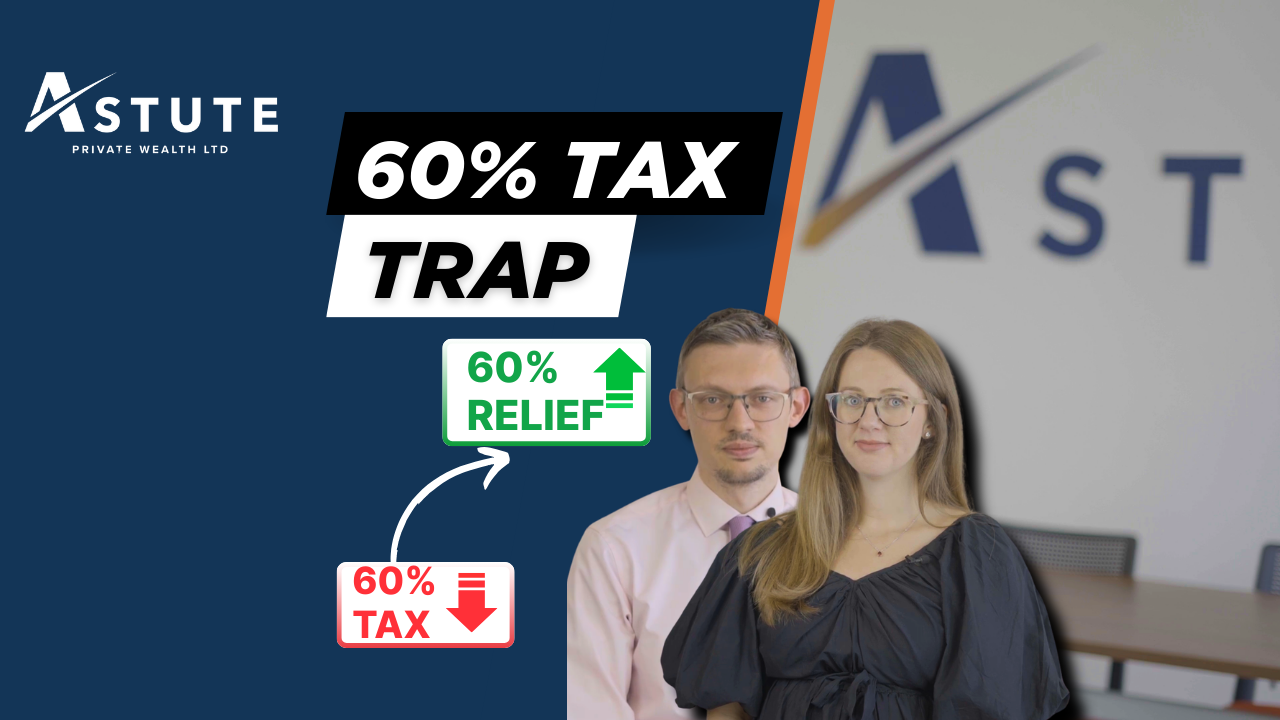
If you earn over £100,000, you could be paying an effective 60% tax rate, without even realising it!
It’s a stealth tax, not writ large in HMRC’s tax tables, but triggered by the quiet withdrawal of your personal allowance.
In this video, we’ll explain how this hidden rate works, how to find out if you may be impacted, and, most importantly, what you can do to avoid it, changing a 60% tax rate into 60% tax relief!
Most people are familiar with the official income tax bands in England, Wales and Northern Ireland: 0%, 20%, 40% and 45%. However, there is quirk in the system that creates an effective 60% tax band for certain earners.
To understand how this effective tax rate works, we first need to look at the basics of how income tax works. It all starts with your personal allowance.
Personal allowance
Everyone starts off with a standard personal allowance, this is an amount each year that you do not have to pay income tax on. In the tax year 2025/26, it is £12,570. In fact, it has been at that level since April 2021.
To illustrate the personal allowance, let’s imagine your income as cash being stacked onto a set of shelves.
- The bottom shelf can fit £12,570, which is your personal allowance, and is therefore tax-free.
- Once you have filled that shelf, you must move to the second shelf. This shelf holds £37,700, and is taxed at 20%. If you fill both shelves, this means that you earn at least £50,270.
- Above that, you have a higher rate shelf, taxed at 40%. Here you can stack the next £74,870 of earned income, which will be taxed at 40%, and taking your total income to £125,140.
- If you earn more than this, then you have an additional top shelf. A huge shelf, that spans towards infinity, where you stack the rest of your income, and pay 45% income tax.
Now, let’s add in that quirk. Once your income exceeds £100,000, your personal allowance starts to disappear, it is eroded at a rate of £1 for every £2 over £100,000.
This means that once you earn £125,140, you’ve completely lost your personal allowance.
This means that the money on the bottom shelf has been displaced, and is taxed as if it was never tax-free to begin with.
You pay 40% on the £25,140 above £100,000 (which is £10,056), plus 40% on the personal allowance you have lost, an additional £5,028 in tax. This totals £15,084 in tax on £25,140 of additional income, which is an effective tax rate of 60%!
You can see the impact here in this table produced by the Institute for Fiscal Studies – a marginal tax rate of 0%, then 20%, then 40%, jumping temporarily to 60% before stepping down to 45%.
Childcare
For those who have young children, there is a further sting in the tail.
In England, the government offers free childcare benefits for children between 9 months and 4 years old. The government also offers “tax-free childcare”, providing you with up to £2,000 a year or £4,000 a year if your child is disabled.
However, if you have adjusted net income over £100,000, you will not be eligible for . This isn’t tapered either – so a £2 pay rise from £99,999 to £100,001 would see you going to eligible for 30 hours free childcare for a 1 year old plus “tax-free childcare”, to not eligible at all, effectively acting as a cliff edge. It is worth noting that free hours for 3-4 year olds is the benefit that remains, despite your level of income.
These benefits differ in other areas of the UK.
Are you impacted?
If you are thinking about whether this will impact you, consider your level of adjusted net income carefully. Start by adding up:
- Your salary
- Any bonuses
- Taxable pension income
- Rental profit after allowances
- And savings interest.
Now remove:
- Your gross pension contributions, and
- Donations to charity.
If this totals over £100,000, then you could be subject to this effective rate.
The near future
If you don’t earn over £100,000 now, but you’re close, then this could pose a problem in the near future. We mentioned earlier that the personal allowance has been frozen since 2021. This achieves what is known as a ‘stealth tax’. As the years pass, average wages increase to ensure that we, employees and consumers, can afford the same lifestyle year on year, as prices increase. However, whilst our income will increase the personal allowance will not, which means that as a society, we will pay more income tax!
How to reduce this
Pension
So, what can you do? One effective strategy is to contribute to your pension! If you contribute into your pension, you can bring down your taxable level of income. Let’s use an example here:
If your salary was £125,140, we have established that you will pay income tax on that £25,000 of £15,000 (an effective rate of 60%). If you instead invest £25,000 into your pension, due to tax relief and reestablishing your personal allowance, you would save tax of £15,000!
Salary sacrifice
You may have heard of salary sacrifice utilised when making pension payments – this allows you to make payments into your pension before your gross income is declared. Many employers offer other perks to staff under salary sacrifice that may reduce your adjusted net income, for example, a car scheme or cycle to work scheme.
Gifting to charity
When you make gift aid donations, these bring down your taxable income.
Assessing income as a couple
For some couples, it may be appropriate to assess how you receive your income collectively. If one of you earns over £100,000, and the other earns much less, is it possible to change working hours between you, or if you are drawing assets, draw them more evenly between you?
Of course this isn’t possible for everyone, but it’s certainly worth exploring for some.
Take aways
The 60% tax trap is surprisingly common, many people fall into it without realising, especially with rising salaries and frozen tax bands.
If your adjusted net income is over, or near £100,000, you could be losing thousands in unnecessary tax, or missing out on valuable childcare benefits. The good news is that, with the right planning, you may be able to reduce your tax bill and reclaim your personal allowance.
A financial planner can help you to identify if your income is at risk, potentially regain your personal allowance and reduce your tax burden in a way that aligns with your goals.
As a reminder, if you have the benefit of working with Astute and this video raises any questions, then please don’t hesitate to get in touch with your Astute financial planner. If you are new to Astute and would like to get in touch, we have created a link that sits below this YouTube video that will guide you to the right place.
See you next time.